See the Places
: Historic Sites & Buildings
: Windmill, Cooper and Rural Trades at Colonial Williamsburg

A useful man was Williamsburg's William
Robertson. Appointed clerk of the colony's Council in 1698, a
director of the fledgling capital in 1705, and a city alderman
in 1722, he also operated a most serviceable windmill.
Reconstructed on its original site,
Robertson's tall, lattice-vaned, linen-sailed machine today commands
Colonial Williamsburg's Windmill, Cooper, and Rural Trades site.
Near it, barrel makers and sawyers work, and farmers tend rows
of 18th-century staple crops like corn, tobacco, and wheat.
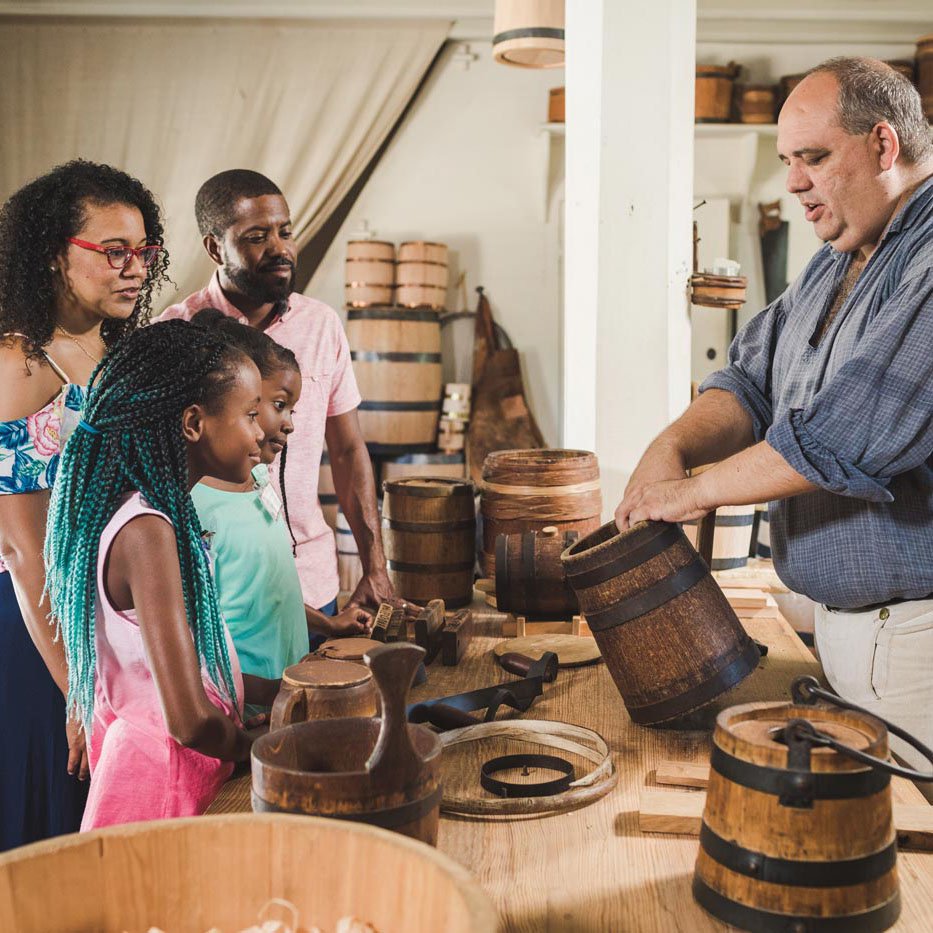
Visitors see how a colonial barrel
was made, wheat was ground, tobacco was packed, a shingle was
split, and a board was sawed or riven.
The windmill was the domain of the miller
and his assistant. Robertson's was a post mill, a design that appeared in
Europe in the Middle Ages. Its superstructure balanced on a huge, single timber--or
post--to be turned into the wind by a man at the tailpole.
When the breeze spun the windmill's blades,
a shaft and gear arrangement turned a millstone to grind corn
into meal or wheat into flour. A bolting or sifting apparatus
on the first floor fed the product into bags.
Traditionally, the miller collected
a toll of one-sixth the weight, but there was room to bargain.
For whatever it may say about Robertson's profits, he sold his
windmill and four city lots to Mayor John Holloway in 1723 for
a modest £80.
In colonial Virginia the real money was in tobacco. Grown, cut, and dried,
it was pried--or "prized"--a thousand pounds at a time into hogsheads
48 inches high and 30 inches in diameter to be shipped to markets in Europe.
From planting to prizing, tobacco production is demonstrated here, as is the
cooper's skill in making
hogsheads.
Colonial coopers made wooden containers for everything from boots to brandy.
Their best barrels, then and now, were fashioned on site from staves sawed,
shaved, and planed
from white oak.
Cedar as well as other woods served for shingles. Demonstrations of how logs
were turned into building products is a specialty of the site, found just beyond
the Peyton Randolph House.

|